About Waterford Virginia
Why
protect Waterford »
Why
we live in Waterford »
Waterford was founded about 1733 by Amos Janney, a Quaker
from Bucks County, Pennsylvania. Other Quakers followed him there. Mills
were built along Catoctin Creek. The village grew until it was the second
largest town in Loudoun County (this was before the Civil War). Many
buildings still in use in the village were built before 1840. More
history
»
Known as Janney's Mill until the 1780s, the early commercial
center then became the village of Waterford. See below on how Wateford
got its name.
Why Waterford
was Designated a National Historic Landmark More »
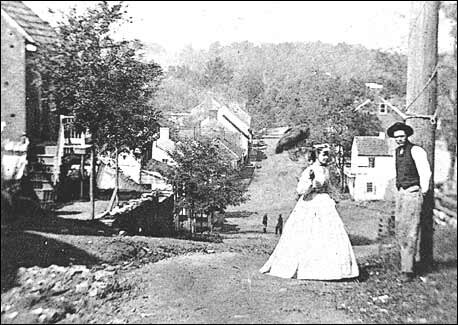
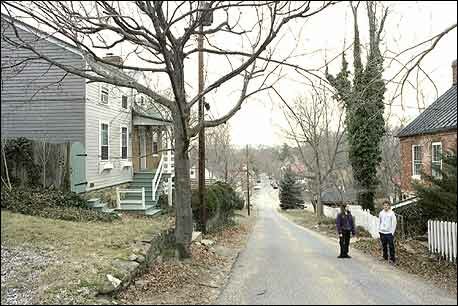
Today, visitors to Waterford,
Virginia, experience many of the same views as residents in the
19th century. Waterford
preserves the ambiance and many of the structures that characterized
it during its heyday as a flour milling town in the 19th century.
The village is a Loudoun
County Historic and Cultural Conservation Site,
on the Virginia
Historic Landmarks Register, on the
National
Register of Historic Places, and in 1970, the entire
village,
with the farmland surrounding it, was designated a National
Historic Landmark District, one of only three such landmarks
in the entire United States.
|
Waterford's stagnation as a commercial center after the
Civil War meant it was not worth demolishing the old to make way for
new development. The old town and its surrounding farms were able to
slumber undisturbed, like Rip Van Winkle, for many years, By 1937,
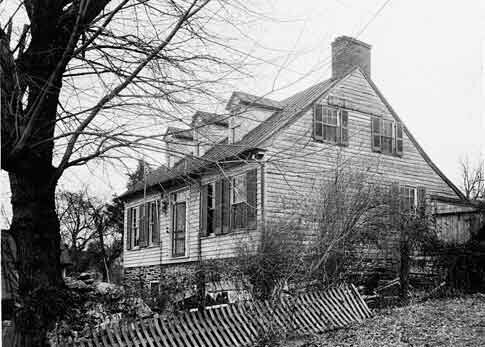
when
the Historic American Buildings Survey was completed in Waterford,
most buildings in the village were falling into
disrepair – or
falling apart.
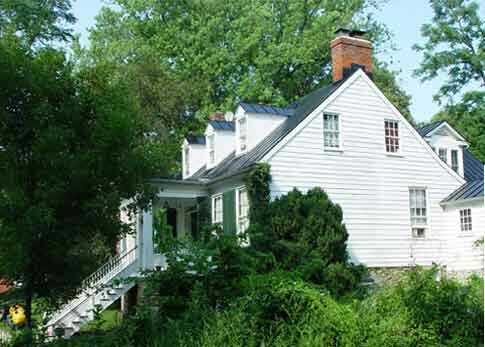
That same decade, members of old Waterford families,
beginning with brothers Edward and Leroy Chamberlin, began buying and
restoring buildings. These restorationists established the Waterford
Foundation in 1943 to "revive and stimulate a community interest
in re-creating the town of Waterford as it existed in previous times
with its varying crafts and activities.
The Foundation has played an important role in revitalizing the physical
fabric of Waterford as well as increasing the public's knowledge of
life and work in an early American rural community. In 1970, Waterford
and 1,420 surrounding acres were designated a National Historic Landmark.
Another 1943 milestone was the creation of the Waterford
Homes Tour and Crafts Exhibit. This annual event now draws some 30,000 visitors
the first weekend every October.
Waterford is 379 ft above sea level, Latitude 39N11,
Longitude77W37
How Waterford got its
name
Waterford had two or three names in colonial
times; Janney's Mill, Fairfax, and Milltown. While the first two
names are part of the historical record, the third's textural appearance
in found first in 1915, the anonymous writer asserting that "Mill
Town" was a name for the village in its founding era. ...
the same anonymous writer, who in 1915 first called the early hamlet "Mill
Town," also forwarded to us the origin of the village's present
name: "One of the most enterprising citizens an Irish Shoemaker
by the name of Thomas
Moore had emigrated this country from or near
Waterford in Ireland. And he very patriotically named the rising
city for the place of his birth..." As to when the name changed,
my property, on the Old Wheatland Road west of Waterford, is described
in a 1770 deed as on "the Great Road to Janney's Mill." Twelve
years later the farm is on "the Great Road from The Gap [later
Hillsboro] to Janney's Mill, now Waterford." Thomas Moore might
have had persuasive powers, for the bustling seaport city of Waterford
has little in common with the village, save for the latter's two
fords and water. Waterford, Ireland, though, did have a substantial
Quaker community.And there were several Janney's mills in Loudoun
County.
From Loudoun Discovered by Eugene
Scheel
| Home | Site
index |
| Waterford
history
| Loudoun
history
|
Virginia,Waterford Va,
historic towns, Loudoun County, civil war towns, villages, village, national
historic landmark